EP. 61 · JUL 14, 2026 · Chiang Mai · Artist · Thailand · Remote Work · Founder Story · AI Automation
61 | The 30-Hour Nomad Workweek – Games, Tech, AI Art and Freedom
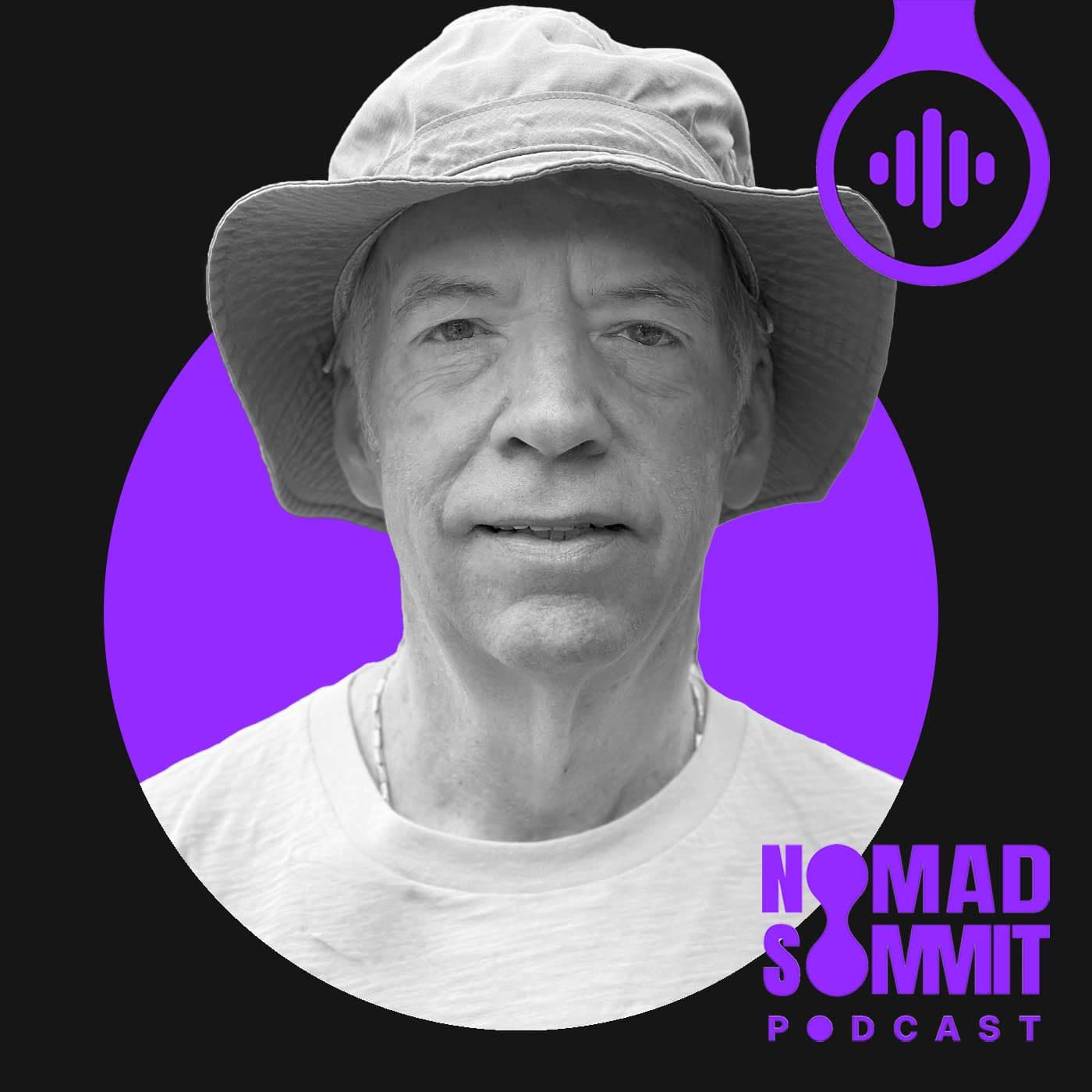
What happens when an early video game developer, AI artist, fractional CTO and digital nomad decides to redesign his life around creativity, exploration and freedom? In this in-person episode, Palle Bo meets Steve Tietze at his new office in Chiang Mai's Nimman neighbourhood.

61 | The 30-Hour Nomad Workweek – Games, Tech, AI Art and Freedom
Key Takeaways
- Chiang Mai's mix of nature, affordability and active communities keeps it a strong base for digital nomads.
- Local meetups provide friendships, professional connections and specialised knowledge that are hard to find elsewhere.
- Combining artistic and engineering skills makes it easier to move between industries, as Steve Tietze did after working on early 3D games connected to Duke Nukem 3D, Doom and Strife.
- Location-independent work makes it possible to hold senior technical roles, such as fractional CTO, without living near company headquarters.
- High-quality AI art takes far more than a prompt; a single 15-second visual could take Steve a week of experimentation.
- Sharing creative work online can lead to collaborations with musicians and projection installations.
Show Notes
Fresh paint, four floors, offices with private showers, and the beginnings of a new coworking community in the middle of Chiang Mai’s Nimman neighbourhood.
It is not the most obvious place for a story that begins with Duke Nukem 3D and ends with psychedelic AI artwork projected onto enormous statues in Thailand. But then again, very little about Steve Tietze’s career follows an obvious path.
In Episode 61 of the Nomad Summit Podcast, Palle Bo sits down with Steve in person to talk about early video games, remote leadership, artificial intelligence, creative reinvention and a decision that many busy entrepreneurs only dream about – cutting the working week to around 30 hours.
Because after years of working 60 to 80 hours a week, Steve decided that professional success was not worth much if he never had time to enjoy his life.
“I blink and five years goes by. I’ve accomplished things, which is cool, but my work-life balance became out of sync.”
Why Chiang Mai Still Works for Digital Nomads
Steve had visited Thailand several times before deciding to make it a more permanent base. When Thailand introduced the Destination Thailand Visa, he already had his own company and a career that could travel with him.
For him, moving to Southeast Asia was an easy decision.
Chiang Mai offered something he had always valued in places such as California and Oregon – access to nature, mountains and open space. But it also offered an unusually active professional and social community.
Steve found AI-art gatherings, advanced engineering meetups and informal groups filled with people building companies, experimenting with technology and sharing what they had learned.
“Anything related to what you’re into, you can find something. There’s always something going on.”
That matters when you arrive in a new country without an existing circle of friends. Steve is comfortable spending time alone, but he also recognises that community is essential.
“I don’t have much of a family, so my friends become my family.”
More Than Cheap Rent and Fast Wi-Fi
Chiang Mai is often promoted to digital nomads because of its affordability, cafés and infrastructure. Steve’s experience points to something deeper.
The city makes it relatively easy to find your people.
For Steve, that includes an advanced weekly AI meetup where engineers discuss new models, development tools and technical experiments. It is not an introduction to ChatGPT. It is a room full of people trying to understand what is arriving next.
In an industry changing almost daily, no single person can follow every update. A strong community becomes a collective filter, with each person bringing something new to the conversation.
From Floppy Disks to 3D Game Development
Steve’s career began long before generative AI, social media and cloud computing.
As a child, he experimented with computers such as the VIC-20, Commodore 64 and Amiga. The Amiga gave him access to early digital art tools, including software that allowed artists to work with what seemed like an astonishing number of colours at the time.
He later attended art school in Dallas, where a new 3D graphics programme offered access to powerful Silicon Graphics machines. These were the kinds of computers being used for groundbreaking visual effects in films such as Jurassic Park – and they could cost tens of thousands of dollars.
Steve arrived with more practical experience than many of the instructors, so he spent as much time experimenting independently as following the curriculum.
When he graduated, there were no online portfolios, video-hosting platforms or instant downloads. His demonstration reel was distributed on VHS tape, while smaller examples of his work were saved on floppy disks with his mailing address written on them.
That portfolio helped him enter the early 3D game industry.
Duke Nukem, Doom and the Birth of Digital Worlds
Steve worked on the early prototyping stages of Duke Nukem 3D before joining Rogue Entertainment, which worked closely with id Software.
At the time, id Software was redefining video games through titles such as Wolfenstein 3D and Doom. Steve’s team used the Doom engine to create Strife, combining first-person action with role-playing elements.
His guest pitch also connects his early career with titles and technology around Quake, placing him close to several of the games that shaped modern 3D development.
He later co-founded Nihilistic Software with two colleagues and moved to the San Francisco area. The small studio received backing from Activision to develop Vampire: The Masquerade – Redemption.
The team had around 12 people, a strict deadline and none of the advantages modern developers take for granted.
There were no enormous day-one updates waiting to repair an unfinished release. The game had to be completed, turned into a final master and physically manufactured in time to match magazine advertising and retail shelf bookings.
It was intense, ambitious work – and it helped establish a pattern that would continue throughout Steve’s life. He was rarely only an artist or only an engineer. He became someone who could move between both worlds.
“My brain is half art, half engineering.”
The Advantage of Being Difficult to Categorise
Steve describes himself as a creative technologist, which may be the only title broad enough to contain everything he does.
Over the years, his work has moved through video games, startups, drones, immersive virtual tours, projection mapping, software development and AI-generated art.
He has built tools for game studios and helped produce drone-based virtual experiences for Burning Man and Fly Ranch. He has also created visuals for musicians including LSDream, LSZee, INZO, Balkan Bump and Bass Temple.
That combination of skills allows Steve to act as a translator. When engineers explain a technical limitation, he can interpret it for an art team. When artists describe what they want to achieve, he can help engineers understand what needs to be built.
In industries where creative and technical people occasionally seem to speak entirely different languages, that ability has become one of his greatest strengths.
Two CTO Roles Without Returning to the Grind
Steve currently divides his professional time between two very different companies.
He works as a fractional CTO with Two Way, an Icelandic platform designed to bring the scattered tools and information used by professional associations into one place.
Instead of members searching across email newsletters, surveys, shared drives, social networks and disconnected databases, Two Way aims to place the organisation’s communication under one roof.
His other CTO role is with Well Inked Memoirs, a company using structured interviews and technology to help people preserve their personal histories.
The idea is that someone could interview a parent or grandparent, organise the stories and eventually create a biography, memoir or coffee-table book for the family. A more automated version may eventually allow users to speak with an app that guides them through the storytelling process.
These are demanding technical roles, but Steve has deliberately structured them around the life he wants.
“What’s important for me is to have my free time, or as much free time as possible.”
He now works around 30 hours a week, splitting his time between the two companies while protecting space for creative work, friendships and exploration.
Escaping the 60 to 80-Hour Workweek
Steve is not pretending that work does not matter. It pays the bills and creates opportunities. But he no longer wants it to consume everything else.
“Work is important. It puts a roof over your head. But it’s not everything in the world.”
Living in Chiang Mai has reduced the amount of money he needs to maintain a comfortable life. That has also reduced the pressure to accept endless hours simply to cover the cost of living in the United States.
“My cost of living has gone down, and the stress of having to make so much money just to survive in the US has gone away. It’s allowed me to breathe and focus on what’s important in my life.”
On his extended weekends, Steve sometimes gets on his scooter, chooses a direction and rides out of the city. Forty or fifty minutes later, he might discover a mountain temple, a roadside restaurant or a coffee shop he never knew existed.
It is the kind of unplanned exploration that becomes impossible when every hour has already been assigned to work.
When AI Art Took Over the Stage
Steve began experimenting with AI-generated imagery years before the current wave of mainstream tools.
The process required a powerful NVIDIA graphics card, Python programming, early generative models and a great deal of patience. The results were often strange, psychedelic and unpredictable – which was exactly what attracted him.
He began producing short visual sequences built around sacred geometry and surreal transformations. After sharing one of them on Instagram and tagging electronic artist LSDream, Steve received a direct message within an hour.
The message was simple: they needed to create something together.
LSDream began sending Steve music and loose descriptions of the atmosphere behind each track. Steve then created collections of visual clips that could be used during live performances.
The collaboration eventually led Steve to Red Rocks Amphitheatre in Colorado, where he saw his work displayed on enormous screens for the first time.
The visuals were synchronised with music, lights and lasers as thousands of people held up their phones to capture the performance.
For Steve, it was both exhilarating and slightly uncomfortable. Like many artists, he could still see every imperfection.
No, It Is Not Just Writing a Prompt
AI art is sometimes described as a process where someone types a sentence and waits for a finished masterpiece to appear.
Steve’s experience is very different.
“For a 15-second clip, I would probably spend a week on it.”
The process involved generating thousands of versions, waiting for the hardware, adjusting the prompts, refining movement and selecting the few seconds that actually worked.
And even then, the artist and the client did not always agree. Steve sometimes included rejected experiments in the files he sent to musicians, only to discover that those were the clips they liked best.
“Art is in the eye of the beholder.”
From Burning Man to 50-Foot Statues
Steve’s work soon expanded beyond concert screens.
At Burning Man, his visuals were projected onto a 71-foot pyramid in the Nevada desert. He contributed the work as a gift, and throughout the night his art appeared alongside pieces from other creators.
He would occasionally ride past on his bicycle, look up at the enormous structure and realise that something originally created on a small computer screen had become part of the landscape.
His projection work later appeared on buildings in San Francisco, including the iconic Ferry Building, and at events such as SF GlowFest.
Through his company, Dreaming Computers, Steve continued creating AI visuals, VJ clips, music videos and immersive installations.
His work at Burning Man eventually led to another unexpected opportunity in Thailand.
The team behind theXperience.samui contacted him about creating visuals for a collection of enormous statues on Koh Samui. Some of the figures were around 40 to 50 feet tall.
Steve designed animated sequences that transformed the statues into different creatures after dark. The projection mapping had to be precise enough to follow every feature of the sculpture.
An eye placed only slightly too far to one side would look completely wrong at that scale.
He initially created the artwork while still in the United States. Later, after moving to Thailand, he was finally able to stand in front of the statues and see the finished work towering above him.
What Comes After the Next Frontier?
Steve is still balancing engineering and art. Intensive software work challenges one part of his mind, while visual creativity helps him recover from it.
He is now considering a more ambitious personal project – a short science-fiction film built around characters and visual worlds he has been developing.
It may become a 15-minute journey through a surreal or dystopian universe. Or it may lead somewhere completely different.
That uncertainty is part of what motivates him.
“What I like is challenges. That’s where I’ll extend myself and work on something new. I’m still waiting for that next challenge.”
A Career Built Around Curiosity
Steve’s story is not really about escaping work.
It is about changing the role work plays in your life.
He has built video games, founded companies, advised startups, created software, collaborated with musicians and projected digital artwork onto buildings, pyramids and giant statues.
Now he is using the freedom of remote work to leave enough room for the next idea – and enough time to enjoy the mountains, friendships and unexpected discoveries around Chiang Mai.
Press play on Episode 61 of the Nomad Summit Podcast to hear the full conversation with Steve Tietze – from floppy disks and early 3D games to AI art, fractional CTO roles and the 30-hour nomad workweek.
Relevant Links
- Steve Tietze on LinkedIn: https://www.linkedin.com/in/stietze/
- Dreaming Computer's website: https://dreamingcomputers.com
- Demo Reel: https://youtu.be/b7STsZ181WY?si=_Ea3KX3wbmMZSdSc
- Steve's Instagram with art: https://www.instagram.com/dreamingcomputers
- Music Video, No Mercy: https://youtu.be/dPPR5NSGxo4?si=cBgiUN5mHkIxU3Sk
- Nomad Summit: https://nomadsummit.com
- Episode produced by RadioGuru: https://radioguru.co.uk
Keep Listening

EP. 79 · Nov 2026 · 36 min
79 | She Runs Two Online Businesses With 7 AI Employees
with Brianna "Bree" Flemings
What does it really take to quit corporate America, move to Thailand, and build a location-independent business? In Episode 79 of the Nomad Summit Podcast…
EP. 31 · Dec 2025 · 31 min
31 | You Get a Co-Working Space: What's Next? With Isaac Cook, RealSpace
with Isaac Cook
This is a special one – the first video episode of the Nomad Summit Podcast, recorded inside the creator studio at RealSpace in Chiang Mai. Palle Bo and…

Oct 2026 · 29 min
75 | 70% of Her Team Is AI – Meet the Egyptian Entrepreneur Building an AI Empire
with Rania Esmael
What if you could run a business where 70% of your team consists of AI agents? And what if one of those agents even applied to be a guest on this podcast…
Aug 2026 · 30 min
65 | Born a Nomad: What Happens When You Finally Have Financial Freedom?
with Doug Mann
What happens when you finally reach the point where work becomes optional? In this episode of the Nomad Summit Podcast, Palle Bo sits down with Doug Mann…

EP. 60 · Jul 2026 · 35 min
60 | Built Different: No-Code, AI, and the New Nomad Entrepreneur
with Jimena Serfaty
In this episode of the Nomad Summit Podcast, Palle Bo sits down with Jimena Serfaty – also known as Jimmy – an Argentine entrepreneur, systems specialist, and…

EP. 56 · Jun 2026 · 35 min
56 | Having a Baby as a Digital Nomad – Pregnancy, Healthcare & Family Life in Chiang Mai
with Kate Guner
After more than seven years of digital nomad life and 37+ countries, Kate Guner thought she knew what freedom, flexibility, and intentional living looked like…

Never Miss an Episode
Get new episodes, event announcements, and nomad insights delivered straight to your inbox.